

आयुर्वेद
ĀYURVEDA
Āyurveda (“the science of life”) forms the foundational understanding of the self in the study of Tantra and Yoga. Without this knowledge, students often wonder how the Yogis or Tantrics understood the self so profoundly, long before the advent of modern anatomical science.. In contemporary medicine, anatomy serves to map the physical framework of the body, primarily for the administration of treatments. Āyurveda, however, offers a more wholistic approach; one that harmonizes the emotional, mental, and physical aspects of the self in a organic and interconnected way. While the study of anatomy takes a reductionist perspective, breaking the body down into parts, āyurveda aligns more closely with what modern scientists call the systems view: a way of understanding how all elements of the body and mind influence each other within the context of the Whole. This unifying vision goes beyond materialist ideologies and reflects a more wholisitc reality of human well-being. It is for this reason that we emphasize the study of āyurveda in our teachings—so that students can cultivate a deeper, more comprehensive understanding of the self.
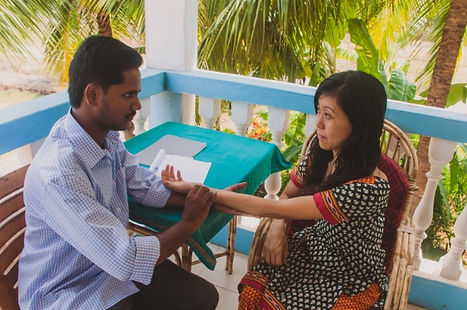
In India, it is well known that in order to progress deeply in Tantra or Yoga, one has to have a solid background in āyurveda. Without this grounding, one falls into not understanding Yoga, but readapting the knowledge to suit one’s own beliefs, rather than receiving these sciences in their full traditional context. At Shri Kali Ashram, students are introduced to both the theoretical and practical aspects of āyurveda. This includes a foundational understanding of key principles such as the dhātus (tissue systems), doṣas,* nāḍis (subtle channels), marma points (vital energy points) and āyurvedic anatomy. In addition, students learn the practical, lifestyle-related aspects of health and healing, including the cleansing techniques known as pañcakarma (“five actions”).
Bhagavan emphasises that āyurveda anticipates an organic science and culture. He explains, “organic here does not mean anti-chemical. It refers to a way of life that avoids the use of substances artificially extracted or isolated from their natural context.”
At Shri Kali, we recognize that many traditional cultures developed analogous wholistic, organic systems of medicine, such as traditional Chinese, Japanese, Greek, and Arabic medicine. Today, however, only Traditional Chinese Medicine and Āyurveda remain widely practiced.. The Greek and Arabic systems are far less common, although Unani (Yūnānī) medicine—a Perso-Arabic tradition with Greek roots—still exists and is practiced in parts of India. In the modern West, the popular system of naturopathy also reflects organic principles, but it is a relatively recent development compared to the ancient and time-tested science of Āyurveda.
Why study Āyurveda?
Tantric texts are the metaphysics or science of the Vedas and āyurveda is derived from this same ancient wisdom. Tantra explains the movement and nature of prāṇa (“life forece”), while āyurvedic texts elaborate on prāṇa in practical terms. Understanding āyurveda can therefore deepen one’s insight into Tantra and enhance the direct experience of its core principles.
An āyurvedic lifestyle means living in harmony with the rhythm of nature—attuning to the changing seasons and respecting the body’s circadian rhythm (the 24-hour internal clock). To truly embrace an organic view of the body, one must adopt a vision embedded in a living, wholistic science: Āyurveda, literally “the science (veda) of life (āyuh).” In both Tantra and Āyurveda, the goal is to optimize, ascend, and ultimately, transcend the body, mind, and soul, which are seen not as separate entities, but as interconnected expressions of a single, wholistic self.
Āyurveda differs from allopathic (Western) medicine as the approach focuses on the individual’s unique nature or constitution (prakṛti) and perceives any illness as a dynamic imbalance within the system, rather than a concrete disease state. This

Chakras – Nāḍīs – Mantras
approach locates and treats the root cause of the imbalance, rather than just suppressing the symptoms.
Through studying āyurveda, you gain insight into your unique constitution and the changing states of the body as expressed through the doṣas: vata, pitta, and kapha.
Doṣa, by definition, is “that which spoils or impairs the quality of the self when in imbalance, and conversely, that which supports and sustains the whole self when in balance.”
Āyurvedic Walking Massage
At Shri Kali Ashram, massage is taught as an integral part of the study of Tantra and Yoga. It is an important practice for maintaining overall health and supporting a long-term yogic lifestyle. Massage helps eliminate toxins from the body, particularly by stimulating the lymphatic system, and preserves the elasticity of muscle fibers—a key factor in sustaining a supple body capable of long-term yoga āsana practice. Regular massage keeps the body flexible and resilient, which is essential for any serious yogi. Beyond its physical benefits, massage also plays a powerful role in enhancing one’s mental state. It promotes a balanced mood and helps release tension, making it easier to enter into deep states of meditation. When the body or mind is under stress, sitting still or meditating becomes difficult. For these reasons, we include massage in our teachings. Additionally, āyurvedic walking massage has been found to support and enhance sexual health, contributing to a balanced and vital energy system.

Āyurvedic walking massage is an ancient therapeutic practice designed to deliver deeper pressure with greater ease and efficiency. With proper training, the feet become precise and responsive instruments, capable of offering highly targeted massage. Hands are used only when necessary, for instance, when working on delicate areas like the face. Compared to hand-based techniques, walking massage is not only more time-efficient but also more effective. Practitioners who rely heavily on their hands often suffer from repetitive strain injuries, tendonitis, and other musculoskeletal issues—ailments that are largely avoided with walking massage. Beyond its physical benefits, walking massage helps cultivate a purified and balanced energy system, supporting overall health and vitality. It is also a powerful tool for healing specific conditions. Many of our students have successfully used it to treat injuries and ailments that modern medicine often deems resolvable only through surgical intervention.
We begin the walking massage on the right side, symbolizing sṛṣṭi—the act of emanation or creation from the Unmanifest Supreme Consciousness. From there, we transition to the left side, representing saṃhāra—the dissolution or reabsorption back into Source. This movement reflects the cosmic cycle: creation (sṛṣṭi), sustenance (sthiti), and eventual dissolution (saṃhāra). On a micro level, this rhythm mirrors the tantric view of existence: the continuous flow of coming into and out of experience, a dynamic dance of transformation. In Tantra, the universe is understood as līlā, a divine play between the polar dimensions of Shiva and Shakti. This interplay is not separate from us; it is expressed within us, since we are sparks of that same Infinite Divine Energy, carrying its boundless potential.
This massage system is also a great way to practice exchanging massage as a gift to each other as well as cultivating a life culture.
Bhagavan learned this ancient system of massage from his grandparents at a young age and has continued to practice it ever since. This traditional form of massage was practiced by both Āyurvedics and Siddhas in South India. Massage can be either simplistic or complex. We teach as much as time allows.


